Frequently Asked Questions
Ask us anything.
The honest answers we give every homeowner, on cost, financing, timelines, materials, warranties, and how we build.
Reviewed June 2026 by Morales Outdoor Living
How does a project with Morales Outdoor Living start?+
It starts with a free on-site consultation. We walk your property, talk through your vision, and identify challenges like slope, drainage, or rock. From there we create a design and a transparent estimate, handle permits and HOA approvals, build with daily progress visible in JobTread, and finish with a full walkthrough.
Is the consultation and design really free, and do you do 3D design?+
Yes. The on-site consultation, the design conversation, and your written estimate are free with no obligation. For larger pool and outdoor-living projects we can produce a visual design so you can see the space before you commit, rather than guessing from a sketch.
Do you handle permits and HOA approvals?+
Yes. We manage permitting, HOA submittals, and utility locates as part of every project, so you do not have to chase paperwork. Many lake and golf communities around Knoxville, Farragut, Loudon, and Tellico have their own review boards, and we have worked through those processes.
How long does a project take?+
Fiberglass pools are typically installed in 3 to 4 weeks; custom gunite pools run 8 to 12 weeks. Most decks and hardscape projects finish in 2 to 4 weeks, depending on size, weather, and site conditions. Design, permitting, and HOA approval happen before that, so the total calendar time depends partly on how quickly those approvals come back.
When is the best time of year to build, and can you build in winter?+
We build year-round, weather permitting. Spring and early summer are the most popular and book out the furthest, but East-Tennessee winters are mild enough that many projects move right along, and booking in the slower months often means a faster start. We will give you a realistic timeline for your specific project at the consult.
How far out are you booked?+
It shifts with the season and the size of the project, with spring and early summer scheduling the furthest out. Reaching out earlier gives you the best options, so getting on the calendar is the surest way to hit the date you have in mind. We will always give you an honest timeline when we meet.
Do you use your own crews or subcontractors?+
You always have one point of contact and one line of communication with us, and we own the project from first conversation to final walkthrough. We build with a core team plus vetted trade partners we have worked with for years, all managed directly by us to the Morales Outdoor Living standard.
What areas do you serve?+
We are based in Knoxville and serve Farragut, Maryville, Alcoa, Louisville, Lenoir City, Loudon, Oak Ridge, Sevierville, Kingston, the Tellico/Watts Bar/Fort Loudoun/Melton Hill/Douglas lake communities, and the surrounding East Tennessee area.
How much does an inground pool cost in East Tennessee?+
Fiberglass pools generally run $70,000 to $190,000+, and custom gunite pools run $95,000 to $350,000+, depending on size, features, and site conditions. Our fiberglass and gunite cost guides break the tiers down in detail.
How much does a paver patio, deck, or outdoor kitchen cost?+
As a rough guide: paver patios and hardscape run about $15,000 to $100,000+, decks $15,000 to $150,000+, and outdoor kitchens $15,000 to $85,000+. The biggest variables are size, materials, and access. Our instant estimate tool gives you a realistic range in about a minute.
Can I get a price estimate online before I call?+
Yes. Our instant cost estimator asks a few quick questions and gives you an honest price range based on real 2026 East-Tennessee project costs. Your exact price still comes from a free consultation, but it gets you in the right ballpark first.
Do you offer financing?+
Yes. We partner with HFS Financial for home-improvement financing with fast online approval, options for every budget, and no home equity required. You can get pre-qualified in minutes without affecting your credit score.
Can I finance a project without using my home equity?+
Yes. HFS Financial specializes in pool and home-improvement loans and does not require home equity, so financing is an option even on a newer home or one without much equity built up. A soft-pull pre-qualification lets you see your options first, and we can walk you through it alongside your estimate so you know your monthly numbers before committing.
Will getting pre-qualified hurt my credit score?+
No. Pre-qualifying through HFS uses a soft credit check that does not affect your score. A hard inquiry only happens if you choose to move forward with a specific loan offer.
Do you require a deposit, and how does the payment schedule work?+
Yes, like most quality builders we take a deposit to schedule the work and secure materials, with the balance tied to milestones as the project progresses rather than everything up front. We put the schedule in writing in your agreement so there are no surprises. Be wary of any contractor who demands full payment before work begins.
What happens if you hit rock or hidden surprises, or I want to change something mid-project?+
Hidden rock, old buried debris, and drainage surprises do come up on East-Tennessee lots, and we handle them with a written change order so you see the added scope and cost and approve it before we proceed. The same goes if you decide to adjust the design partway through. It is all tracked in JobTread, so nothing is added to your bill without your sign-off.
Why is the cheapest quote usually a mistake?+
In hardscape and pools, most failures trace back to skipped base prep, thin excavation, or cut corners you cannot see. A patio set on topsoil or a pool backfilled improperly looks fine for a season, then shifts. We engineer for East-Tennessee clay and freeze-thaw, which costs more upfront and far less over the life of the project.
Are you licensed and insured?+
Yes. Morales Outdoor Living holds Tennessee Residential and Small Commercial Contractor license #77919 and carries insurance, and we are glad to provide documentation. We have been building outdoor living spaces in East Tennessee since 2017 and carry a 4.9 star rating across our reviews. We encourage every homeowner to verify a contractor license and coverage before signing, with us or anyone.
What is the difference between a workmanship warranty and a manufacturer warranty?+
A manufacturer warranty covers defects in the product itself, the fiberglass shell, the pavers, the turf fibers, while a workmanship warranty covers how it was installed. Both matter, because a product warranty does not help if the install was done poorly, and that installation gap is exactly where cheap jobs fail. We stand behind our workmanship and pass along the manufacturer warranties on the products we use, spelled out in writing on your project.
What happens if something goes wrong after the job is finished?+
You contact us directly. Because you have had one point of contact from start to finish, there is no finger-pointing between subs, we coordinate the fix and work with the manufacturer if it is a product issue. We document the whole build in JobTread, so there is a clear record of exactly what was done.
How do I know the project will not cause drainage problems or affect my neighbors?+
Drainage is something we plan for up front. We assess how water moves across your site during the consultation and design the base, grading, and any needed drainage so runoff goes where it should, not toward your foundation or a neighbor yard. Being licensed and insured also protects you if anything unexpected happens.
Do you clean up and restore my yard when you are done?+
We clean up the work area, haul off our construction debris, and do light grading around the finished project. Full yard finish work, things like final regrading, sod, or landscape repair, is quoted at the end of the project rather than up front, and here is the honest reason: how torn up the surrounding yard gets depends on the weather and rain during the build, which no one can know until the work is done. So we price that restoration once we can see the real condition of the site, instead of guessing high or low at the start. We also handle utility locates up front so digging is done safely.
Should I choose a fiberglass or gunite pool?+
Fiberglass is faster (3 to 4 weeks), lower-maintenance, and a great fit for flat lots and standard shapes. Gunite is built on-site in any shape with unlimited customization and the highest resale value, ideal for sloped lots, custom designs, and luxury features. We build both and will tell you honestly which fits your yard and budget.
What is the difference between gunite and shotcrete?+
Both are concrete sprayed through a hose under pressure to form a pool shell in place over steel reinforcement. Gunite is the dry-mix method, water is added at the nozzle, and it is the dominant technique across Tennessee and the Southeast. Shotcrete is the wet-mix version more common out west. Properly placed, both cure into a comparable steel-reinforced concrete shell, the real difference is regional terminology, not the finished pool.
Do you build shotcrete pools in Knoxville?+
We build with gunite, not wet-mix shotcrete, gunite is the standard sprayed-concrete method here in East Tennessee. If you came from a state where shotcrete is the local term, you are looking for the same result: a fully custom, sprayed-concrete pool built entirely on site. That is exactly what we build.
Should I get a saltwater or a traditional chlorine pool?+
Both are chlorine pools, the difference is how the chlorine is delivered. A saltwater system makes its own chlorine from dissolved salt, so the water feels softer, is gentler on skin and eyes, and you handle far fewer chemicals; a traditional system costs a little less up front but means adding chlorine yourself. Saltwater pairs especially well with fiberglass because the gelcoat surface is unaffected by salt. We will walk you through which fits your finish, budget, and maintenance preference.
How deep should my pool be, and can I have a diving board?+
It depends on how you will use the pool. Most families are happiest with a 3.5 to 5 foot sport depth that keeps the whole pool usable for playing and lounging. If you want deeper water for diving and play, fiberglass goes deeper than most people think: several Imagine Pools models we install have an 8 foot deep end, and a custom gunite pool can be built to any depth. A diving board is a stricter, separate question, it calls for a specific deep-end depth, length, and floor shape that meets safety standards, plus manufacturer approval on a fiberglass shell, so whether a given pool can take a board comes down to the exact model and design. We will walk you through the deep-water and diving options before you commit.
Can I add an attached spa or hot tub to my pool?+
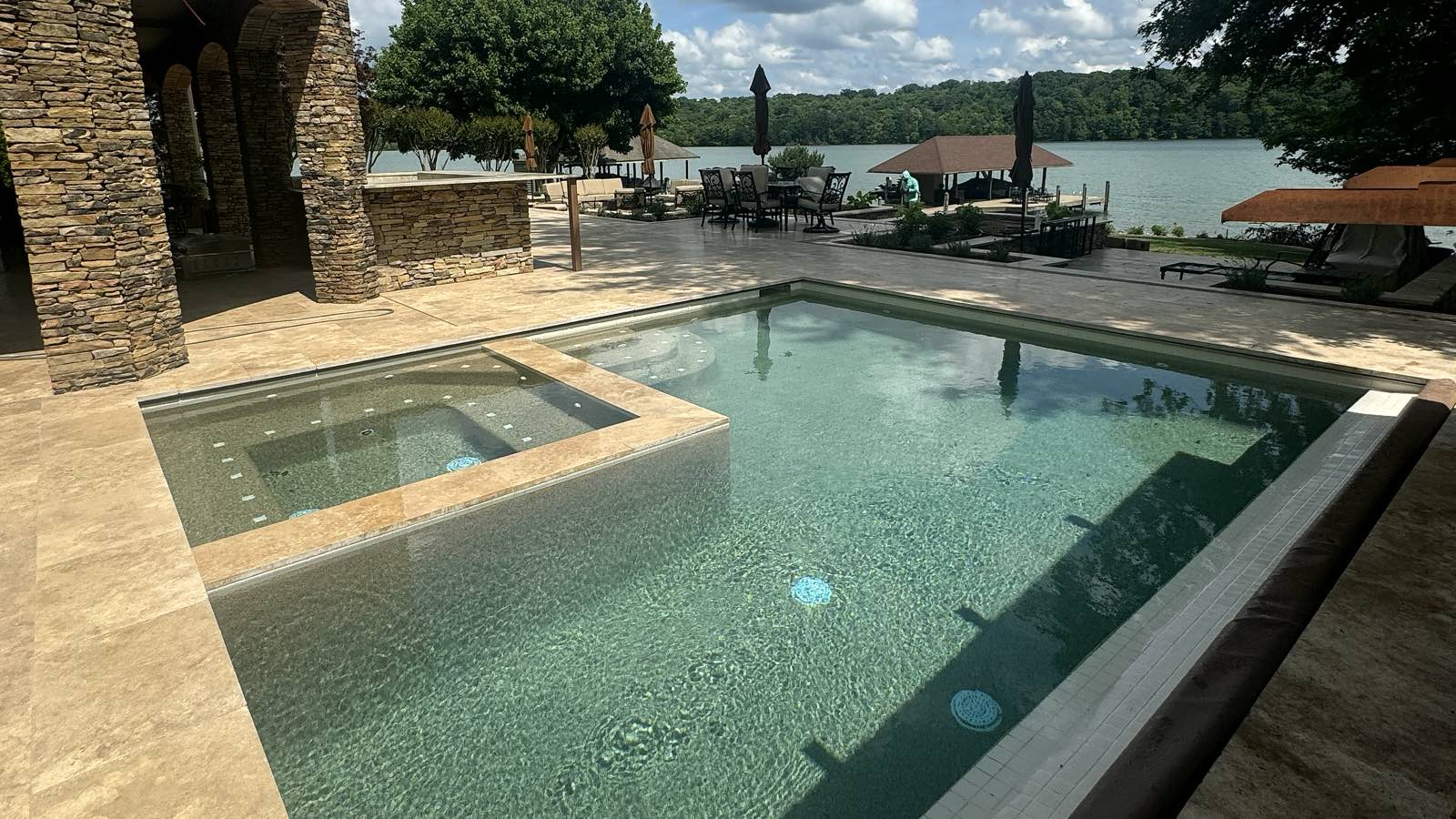
Yes, and building it at the same time as the pool is far more cost-effective than adding one later. A spillover spa shares the pool equipment and circulates water back into the pool, which looks great and helps keep the water moving. Whether you want a raised spa, a spillover, or a separate standalone unit, we design it into the plan from the start.
What is a tanning ledge (Baja shelf), and is it worth adding?+
A tanning ledge is a shallow shelf, usually only a few inches of water, built into the pool for lounge chairs, small kids, and pets. It is one of the most popular upgrades because it adds a resort feel and a safe, comfortable spot to cool off without treading water. The main trade-off is footprint, so on smaller pools we balance it against open swimming space.
Can you build a pool on a sloped or rocky lot?+
Yes, and it is common here. Sloped and rocky East-Tennessee lots often need retaining work or rock excavation, which we scope upfront so there are no surprises. Gunite is especially well-suited to challenging lots because it is built to your exact site.
How long do pools last?+
A well-built gunite shell is essentially permanent (30 to 50+ years); the interior finish is what ages, with plaster lasting 10 to 15 years and pebble or quartz 15 to 25. Quality fiberglass shells last 20 to 35 years with simpler surface maintenance.
Does a pool add value to my home in East Tennessee?+
A well-built inground pool makes a home more attractive and competitive, especially in desirable lake and family neighborhoods, but you generally should not expect the appraised bump to equal what you spend. For most of our clients the bigger payoff is years of daily enjoyment at home. If resale is a major factor for you, we are happy to talk it through honestly at the consult rather than overpromise.
What does it cost to heat a pool, and how much longer can I swim?+
A heater is the single best way to stretch our season, since East-Tennessee springs and falls are mild and heating adds comfortable swim time on either end. An electric heat pump is very efficient to run in moderate temperatures, while a gas or propane heater heats faster and works better in colder weather, so many homeowners choose based on how early and late in the year they want to swim. We will size and recommend the right option for your goals and utility setup.
How much will a pool cost and take to maintain?+
Routine upkeep means brushing, skimming, checking chemistry, and emptying baskets, plus budgeting for chemicals, electricity, and water. Fiberglass pools are the lightest lift because their smooth, non-porous surface resists algae and uses fewer chemicals and less electricity than concrete. Many owners automate part of it with a cleaner and a cover or hire a service, and we will show you exactly what your pool needs so it stays easy.
Do I need a fence or alarm around my pool?+
Pool barrier rules vary by city, county, and HOA, but most local codes call for a barrier around 48 inches tall with self-closing, self-latching gates, and many jurisdictions also require a door or pool-entry alarm. We confirm the exact requirements for your address and build to code as part of permitting, so you are covered without having to decode the rules yourself.
Are automatic safety covers worth it if I have young kids or pets?+
For families with small children or pets, an automatic cover is one of the best safety and convenience investments you can make, it slides over the water at the push of a button, and quality covers are engineered to hold significant weight. Beyond safety it keeps debris out, cuts evaporation and heat loss, and reduces how hard your pump and filter work. A cover is never a substitute for supervision, but it is a strong added layer of protection.
How do you winterize a pool in our freeze-thaw climate?+
East-Tennessee winters swing above and below freezing, so proper closing matters. The most important step is clearing water out of the plumbing lines so nothing freezes and cracks; we also lower the water to the right level (never fully drained, the water weight protects the structure), balance the chemistry, and cover the pool. Done correctly, winterizing protects your equipment and shell and makes spring opening much easier.
What warranty comes with a pool?+
Pool warranties fall into two buckets: the structural shell and the workmanship and components. As an authorized Imagine Pools dealer, our fiberglass shells carry the manufacturer structural warranty, and we stand behind our installation work; equipment like pumps, heaters, and lights carry their own manufacturer warranties. We go over exactly what is covered, and for how long, in writing before you sign.
Why do so many patios and walls fail in East Tennessee?+
Our red clay swells when wet and shrinks when dry, and winter freeze-thaw cycles lift anything on a shallow base. Most failures come from inadequate excavation and base prep, not the stone itself. A properly excavated, compacted aggregate base is what keeps a patio or wall stable for decades.
Do paver patios sink or shift over time?+
A properly built one should not. Pavers sink when the base was skipped or under-compacted, not because of the pavers themselves. Our red clay and freeze-thaw cycles are exactly why we do not cut corners on excavation and base depth, and a patio built on a deep, compacted aggregate base with proper drainage stays put through every season.
How deep does the base under a paver patio need to be?+
For a walk-on patio we typically want several inches of compacted, graded crushed stone, placed in lifts rather than dumped all at once, with a deeper base for anything carrying vehicle loads like a driveway. Our local clay and freeze-thaw are why the base, not the paver, is what we obsess over, since it is what absorbs frost movement. We confirm the right depth for your soil and use during the consult.
Will weeds grow up between my pavers?+
Far less than people expect when the joints are filled with polymeric sand, which hardens to resist weeds and washout. Most weeds you see in older patios are actually windblown seeds that rooted in surface debris on top, not growth pushing up from below. Keeping the patio swept and the joints maintained handles the rest.
Do I need to seal my pavers, and how often?+
Sealing is optional, not required, but many homeowners like it for richer color and stain resistance. If you seal, the usual guidance is to wait several months to a year after install so the pavers fully cure, then reapply every few years. Unsealed pavers still last a long time; sealing is mostly about appearance and easier cleanup.
Pavers, stamped concrete, or poured concrete, which should I choose?+
All three can look great; the difference shows up over years in our climate. Poured and stamped concrete are single slabs that can crack along freeze-thaw and clay movement, and stamped concrete needs periodic resealing to keep its look. Pavers flex with ground movement, individual units can be lifted and replaced, and they generally outlast concrete here. We will walk through the trade-offs and budget at your consult.
How long does a paver patio last?+
With a proper base and edge restraints, a quality paver patio can last for decades, often outliving a comparable concrete slab. The pavers themselves are extremely durable; longevity comes down to the base prep underneath, which is the part we focus on most.
Can you install pavers over my existing concrete patio?+
Sometimes, but it is not always the right call. Concrete does not drain, so without careful slope and detailing water can get trapped between the slab and the pavers, and freeze-thaw can turn that into shifting and damage; any cracks or settling in the old slab can also telegraph up through the pavers. If the existing concrete is sound and drains well it can work, otherwise removing it and building a proper base is the more durable choice. We will assess your slab and tell you honestly which way to go.
One paver is cracked or sunken, can it be repaired without redoing everything?+
Yes, that is one of the big advantages of pavers. A single unit can be lifted out, the base spot-corrected, and the paver reset or replaced, no need to tear up the whole patio. The key is fixing the underlying cause, usually a base or drainage issue, so the repair actually lasts.
Do I need a permit or engineering for a retaining wall?+
Taller and structural walls often require engineering and permits, which we handle. Beyond height, proper drainage and base are what separate a wall that lasts from one that bows out in a few years.
How tall can a retaining wall be before it needs engineering?+
In East Tennessee the rule of thumb is 4 feet: a wall over 4 feet of retained height, or any wall holding back extra load like a driveway or a slope above it, needs an engineered design and a permit, which we handle. Under 4 feet a wall usually does not need engineering, though our red clay and the water it holds make proper drainage and base prep just as important at any height. We handle the engineering and permits whenever a wall calls for it, so you have one point of contact through the process.
Why do retaining walls bow, lean, or fail?+
The number one enemy is water. When the soil behind a wall saturates it creates pressure that builds until it pushes the wall out, and our clay holds water like a sponge. The fix is not a thicker wall, it is proper drainage, gravel backfill, a drain at the base, and on taller walls geogrid reinforcement tied back into the soil. Most failures we are called to repair trace back to skipped drainage and base prep, not the block.
What goes on behind a retaining wall to keep it from failing?+
A correctly built wall is mostly about what you do not see: a compacted footing, free-draining gravel backfill, a perforated drain pipe to carry water away, and often geogrid layers anchoring the wall into the hillside on taller builds. That is what relieves the water pressure that causes most failures. We build the drainage in from the start, because retrofitting it later means tearing the wall apart.
Block wall or natural stone, what is the difference?+
Both can be excellent; it comes down to look, site, and budget. Segmental block gives a clean, engineered, modular system that handles height and curves well; natural stone gives a more organic, rugged look and can last a very long time. The deciding factor on either is still drainage and base prep, not the visible face. We will match the material to your slope, style, and budget.
How long should a retaining wall last, and is terracing better than one tall wall?+
A properly engineered and drained wall can last for decades, and natural stone walls often longer still, lifespan is dictated by the foundation and drainage rather than the visible material. Breaking a tall slope into two or more shorter, stepped walls can reduce the load on any single wall, improve drainage, and create usable space between levels. We will look at your grade and recommend whether one wall or a terraced approach makes more sense.
Composite or wood decking, which is better here?+
Composite (Trex, TimberTech) costs more upfront but resists rot, fading, and insects and needs almost no maintenance, which pays off in our humidity. Pressure-treated wood is cheaper initially but requires regular sealing and has a shorter lifespan. We build both and help you weigh lifetime cost.
Does composite decking get too hot to walk on?+
Composite can run warmer than wood in direct sun, and color is the biggest factor, darker boards get hotter, lighter tones stay closer to wood. For a deck in full afternoon Tennessee sun it is worth weighing. We can steer you toward lighter colors or sun-friendly product lines from Trex and TimberTech if heat is a concern.
How long does a deck last, wood versus composite?+
A pressure-treated wood deck typically lasts in the 10 to 15 year range with regular upkeep, while quality composite from Trex or TimberTech commonly lasts 25 years or more. Either way the substructure and footings determine real longevity as much as the surface boards. We build both, so we will help you weigh upfront cost against years of service and maintenance.
How deep do deck footings need to be here?+
Footings need to bear below the frost line so the deck does not heave when the ground freezes, and our higher East-Tennessee elevations can call for deeper footings than the valley floor. On sloped or hillside lots, footing design gets more involved. We size and place footings to local code and your specific soil and grade, and we handle the permit and inspections that go with it.
Do I need a permit and inspection for a deck, and what gets checked?+
Most attached and elevated decks require a permit, with thresholds that vary by city and county, while low freestanding ground-level decks are sometimes exempt. Inspectors pay close attention to the ledger attachment and flashing where the deck meets the house, since a failed ledger is a leading cause of deck collapses. We pull the permits, build to code, and manage the inspections so it is not on you to navigate.
Can you build a deck on a steep lot, and can the space underneath stay dry?+
Yes, sloped and hillside lots are common here, and an elevated or multi-level deck is often the best way to turn an unusable slope into living space. On taller decks we can add an under-deck drainage system that channels water away and creates a dry, usable area beneath, which can later be finished with a ceiling, lights, or a fan. We design the footings, drainage, and layout around your grade.
Will my outdoor kitchen survive East Tennessee winters?+
Yes, when it is built right. We use outdoor-rated stainless appliances and weather-resistant cabinetry, plus countertop materials that handle freeze-thaw, so the structure overwinters outdoors with no problem. The main seasonal task is draining any water or ice-maker lines before a hard freeze and covering the grill and fridge during the coldest stretches, and we walk you through that simple routine at handoff.
Do I need gas, water, and electric run to my outdoor kitchen?+
It depends on the features you want. A grill island can run on a hidden propane tank with no utilities at all, but a natural-gas grill, sink, ice maker, fridge, or lighting each needs its own rough-in. We coordinate the electrical and gas or water rough-ins through our vetted, licensed trade partners so it is permitted and correct, and placing the kitchen closer to the house generally keeps those runs shorter and less expensive.
Should I go built-in or modular for an outdoor kitchen?+
Built-in masonry kitchens are permanent, more durable, and tend to add the most resale value, which is why most of our clients choose them. Modular and prefab units assemble faster and cost less up front but can look temporary or show wear over time. Our builds range from grill islands to full luxury culinary spaces, and we will help you match the approach to your budget and how long you plan to stay.
Can I put an outdoor kitchen under a covered patio or pavilion, and does it need a vent hood?+
Absolutely, and it is one of the most popular setups in our climate because it protects you and the appliances from sun and rain. Once a grill sits under any solid roof, a proper vent hood becomes essential for heat, smoke, and grease, and skipping it can even void appliance warranties. Note that a cover or pavilion is priced as a separate add-on from the kitchen itself.
What countertop material is best for an outdoor kitchen here?+
Dekton and porcelain (sintered stone) are our top picks for outdoor use: non-porous, UV-stable so they will not fade, freeze-thaw resistant, and no sealing required. Granite is beautiful and strong but porous, so it needs periodic resealing to hold up outdoors. We build all the way up to full luxury culinary spec, including premium masonry and Dekton counters.
Are a pizza oven, smoker, or kegerator worth adding?+
For homeowners who genuinely cook and entertain outdoors, these are the features that get used the most and make the space a destination, which is why we build everything from grill islands up to full setups with pizza ovens and kegerators. They do add cost and require gas, power, or plumbing, so we recommend prioritizing the pieces that fit how you actually host. We will talk through the trade-offs at your consult.
Does an outdoor kitchen add resale value?+
A well-executed permanent outdoor kitchen is one of the stronger outdoor-living investments and a real draw for buyers in the Knoxville market, where outdoor entertaining is a year-round lifestyle. The value holds when the build is quality and well-maintained; cheap or aging units can become a negotiating point against you. That is a key reason we build with durable materials and proper permitting.
What is the difference between a pergola, a pavilion, and a gazebo?+
A pergola has an open slatted roof for filtered shade and architectural beauty, but it does not block rain. A pavilion has a solid, often peaked roof with open sides, giving full sun and rain protection, while a gazebo is typically round or multi-sided and more enclosed. We build open cedar and timber pergolas and solid-roof wood and timber pavilions, and we will help you pick based on whether you want dappled light or true all-weather cover.
Do pergolas actually provide shade and rain protection?+
An open wood pergola gives partial, dappled shade and defines a space beautifully, but rain passes right through it. If you need to stay dry and want usable shade in any weather, a solid-roof pavilion or a louvered aluminum cover is the better fit. Many clients pair a pergola look with one of those for true protection, and we can advise on the right combination.
Wood, vinyl, or aluminum for a pergola?+
We specialize in natural cedar and timber for their warmth and classic look, which suits a lot of East-Tennessee homes; cedar resists insects and moisture and lasts 15 to 25 years with regular sealing. Aluminum is the most maintenance-free and longest-lasting (and what our louvered covers use), while vinyl is low-maintenance but weaker under wind and snow loads. We will match the material to your aesthetic and how hands-on you want to be.
Do I need a permit for a pergola or pavilion?+
Usually yes for anything substantial, and the rules differ by jurisdiction and HOA. Anything attached to the house almost always needs a permit and engineered connection details, and many freestanding structures do too. We handle permits, setbacks, and HOA approvals for you as your single point of contact, and confirm the exact requirements for your address.
Should my pergola or pavilion attach to the house or be freestanding?+
Attaching it ties the structure into your roofline and can feel like a true extension of the home, but it requires a permit and an engineered connection. Freestanding gives more placement flexibility and is simpler to permit, though it still needs proper footings. We will assess your home, grade, and goals and engineer it correctly either way.
Can I add lights, fans, heaters, or screens to my pergola or pavilion?+
Yes, these are some of the most-requested upgrades and they dramatically extend how many months you can use the space. We design the structure to conceal wiring in the beams and run wet-rated, outdoor-listed electrical through our licensed trade partners, so fans, LED lighting, infrared heaters, and screens are clean and code-compliant. It is best to plan these in at design time so the wiring and supports are built in.
How much maintenance does a cedar pergola need, and how long will it last?+
A cedar or timber structure typically lasts 15 to 25 years, and the single biggest factor is resealing or restaining it every one to three years to protect it from our humidity and rain. Kept up, the wood stays beautiful and structurally sound; neglected, it can cup, crack, and decay much sooner. If you would prefer near-zero upkeep, we can discuss a low-maintenance aluminum alternative.
What is the difference between a louvered and a solid aluminum cover?+
As an authorized Outdoor Elements dealer and installer, we install both. Louvered roofs rotate open for sun and close tight against rain, controlled by remote or app, including motorized and rain-sensor options. Solid insulated covers are fixed, lower-cost, and can drop patio temperatures dramatically on hot days.
Do louvered roofs leak when it rains or snows?+
No, a quality louvered roof seals tight when closed. Our Outdoor Elements louvers rotate fully open for sun and close to a watertight seal against rain, with integrated gutters channeling water away, and the system is engineered for heavy rain and snow load. On motorized models, rain sensors close the louvers automatically if a storm rolls in while you are away.
Motorized or manual louvered roof, and is the motor worth it?+
For most homeowners the motor upgrade is worth it: it is a small share of the total cost but the feature you will touch every day, with remote or app control and automatic rain-sensor closing. Manual systems cost less and use a crank but cannot close themselves in sudden wind or rain. We will size the right option for how often you expect to adjust the roof.
Do aluminum patio covers get hot and trap heat underneath?+
Powder-coated aluminum reflects most of the sun heat rather than soaking it in, so it stays far cooler than you would expect. A louvered roof has a real edge here because you can crack the louvers open to vent built-up warm air and pull a breeze through, something a fully solid cover cannot do. Adding a ceiling fan keeps air moving on the hottest Tennessee afternoons.
Do aluminum covers and pergolas hold up to Tennessee weather?+
Yes. Powder-coated aluminum never rots, warps, rusts, or needs repainting, and Outdoor Elements systems are structurally engineered for wind, snow load, and heavy rain, with integrated gutters and rain sensors on motorized models.
Can I add screens, heaters, or lighting to a louvered roof?+
Yes, louvered systems are designed to integrate add-ons like motorized screens, infrared heaters, fans, and LED lighting, which turn the space into a true three-season room or longer. These are best planned in at design so the structure, power, and supports are built to carry them. We coordinate the electrical rough-ins through our licensed trade partners.
What kind of warranty comes with an aluminum cover?+
These systems carry strong manufacturer warranties on the structure and components, and we review the specific coverage for your model at your consultation. On permitting, covered structures generally require a permit and have setback rules that vary by jurisdiction, and we handle the permit and any HOA approval for you.
Is artificial turf safe for pets and kids?+
Yes. Modern artificial turf is non-toxic, lead-free, and designed with drainage and infill options specifically for pets and play areas. It stays green year-round, eliminates mud, and drastically cuts watering and mowing.
Does artificial turf get too hot to walk on in the summer?+
On a full-sun July afternoon turf does warm up more than natural grass, just like a patio or deck does, but a quick rinse with the hose drops the temperature almost instantly. Choosing a lighter-toned grade and the right infill keeps it more comfortable underfoot, and shade from trees, pergolas, or sails helps a lot. For most East-Tennessee yards with afternoon shade, heat is rarely an issue.
Will artificial turf drain after our heavy Tennessee rains, or will it puddle?+
Properly installed turf drains right through a perforated backing into a compacted, permeable base, so it sheds water faster than most natural lawns and will not leave you with a muddy yard. The key is the base prep and grading, which we engineer for your site so water moves where it should. Done correctly, you can walk on it shortly after a downpour.
How do you keep pet turf from smelling like dog urine over time?+
Odor comes from ammonia building up when urine sits in the backing, so the fixes are good drainage, an odor-control infill that traps ammonia, and routine rinsing. We install pet-specific systems with infill and drainage built for this, and a periodic hose-down plus an occasional enzymatic cleaner keeps things fresh. We will walk you through the simple routine at handoff.
How long does artificial turf last, and will it fade?+
Quality, UV-stabilized turf installed on a proper base typically lasts around 15 to 20 years, with the base often outliving the turf itself. Because it is UV-stabilized, it resists the bleached, plasticky look that cheap turf develops after a couple of summers and holds its color well across its lifespan. That UV protection and the base prep are the biggest differences between premium and bargain turf.
What infill do you use, and is it safe for kids and pets?+
We use non-toxic, lead-free systems and select the infill by use case, typically sand-based or odor-controlling options for pet and play areas. The infill weighs the fibers down so the turf stays upright and realistic, helps with drainage and odor, and keeps the surface stable. We are glad to tell you exactly what is going into your project.
Can you put turf right over dirt or my existing grass, and will weeds grow through it?+
We do not lay turf directly over living grass or loose dirt, because that is what leads to weeds, lumps, and early failure. We remove the existing vegetation and build a compacted, draining aggregate base with a weed barrier underneath, which is what makes the surface smooth, stable, and weed-resistant for the long haul. Proper base prep is the single biggest factor in how good turf looks and how long it lasts.
Can artificial turf be installed on a slope or hillside?+
Yes. Slopes are common in East Tennessee, and turf installs well on them when the base is properly graded and compacted and the turf is securely anchored at the top and edges so it cannot shift or wrinkle. On steeper grades we add extra securing and erosion control. We assess the slope during your on-site consultation and build the base accordingly.
How realistic and fast is a backyard putting green, and can you tune the speed?+
Our putting greens use dense, fine-bladed putting turf that rolls true, and we can tune green speed by adjusting the sand infill, more for a faster roll, less for slower. We can also build in contours, breaks, and multiple cup positions so it plays like a real green. We will dial the speed to your preference during design, and upkeep is just occasional brushing and topping up the infill, no watering, mowing, or chemicals.
Over time, is turf really cheaper than reseeding or laying sod?+
The upfront cost of turf is higher, but you eliminate watering, mowing, fertilizer, and reseeding, and most homeowners reach a break-even point within the first several years. Our turf runs roughly $13 to $35 per square foot installed depending on grade, landscape, pet and play, or putting green, and after that the ongoing cost is minimal. For high-traffic spots or shady areas where grass struggles, the value shows up even faster.
What happens with snow and ice on turf in winter?+
Turf handles East-Tennessee winters fine, snow melts and drains through just like rain, and light snow can be left to melt or swept off. You can shovel gently with a plastic blade if needed, but avoid metal edges and heavy salt. Because it drains so well, you will not get the standing slush and mud a dormant natural lawn gives you.
Still have a question? Get an instant estimate, explore financing, or just ask us.
Didn't Find Your Answer?
Tell us about your project and we'll give you a straight answer.